Mitochondrial transplantation is a new therapeutic intervention to treat ischemia-reperfusion injury caused by interrupted and restored blood flow. The method for mitochondrial transplantation is simple and rapid: It can be delivered to the end organ either by direct injection or intraarterial infusion.

Cell-based therapies for myocardial repair or regeneration have shown great potential. However, the efficacy of specific cell populations, the logistics of cell harvesting and expansion, and the mechanisms of cell-based myocardial repair or regeneration have yet to be established. Most importantly, difficulties over cell purification and immune tolerance, as well as cell engraftment, integration, and function remain. That is why strategies to augment cell delivery, function, and survival are crucial for successful myocardial repair or regeneration through cell-based therapies.
Breakthrough mitochondrial transplant research

The McCully Lab has demonstrated that autogeneic (autologously-derived) mitochondria isolated from the patient’s own body — from remote tissue unaffected by ischemia — and then directly injected into the ischemic zone of the myocardium during early reperfusion significantly decreases myonecrosis and significantly enhances post-ischemic functional recovery in vivo. Our studies show that transplanted mitochondria initially act extracellularly to enhance energy production in the target organ. The transplanted mitochondria are then taken up by cells and further increase oxygen consumption rates and ATP content. The transplanted mitochondria cause no electrical abnormalities or immune or auto-immune reactions. The transplanted mitochondria act to increase tissue protective cytokine production and up-regulate the signaling pathways associated with mitochondrial function and energy metabolism.

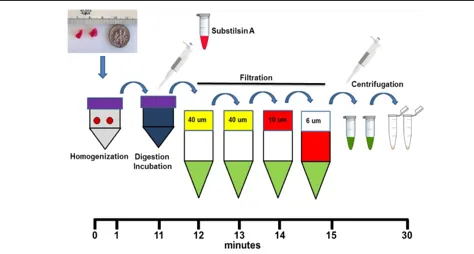
Figure X. Schematic overview of the rapid isolation of mitochondria from tissue. A small tissue sample is homogenized, enzymatically treated with Subtilisin A, and sequentially filtered through 40-, 40-, 10-, and 6-µm filters to remove tissue debris. The filtrate is then centrifuged to collect the mitochondria. The complete isolation procedure is performed within approximately 30 minutes.

The promise of therapeutic treatment

Autogeneic mitochondrial transplantation provides immunological advantages for practical application without the use of anti-rejection drug therapy. The transplantation of autogenic mitochondria could be used either as an exclusive intervention to ameliorate myonecrosis and enhance myocardial function, or it could be used as a primary intervention prior to subsequent auto-, allo- or xeno-geneic cellular regenerative interventions.

Our lab has demonstrated that transplanted mitochondria are internalized by a variety of cell types including cardiomyocytes, fibroblasts, skeletal myoblasts, cortical neurons, microglial cells, and astrocytes. These studies demonstrate that transplantation of autogeneic mitochondria offers a unique therapeutic opportunity that extends beyond their use for myocardial ischemia and reperfusion injury.

We have conducted clinically relevant, long-term survival, large animal studies to demonstrate the efficacy of mitochondrial transplantation in ischemia re-perfusion injuries of the heart, lungs, kidneys and limbs.