Overview
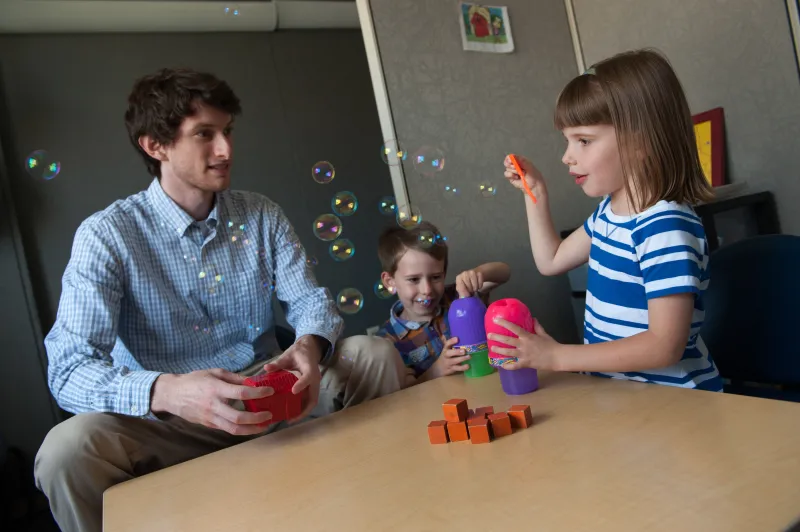
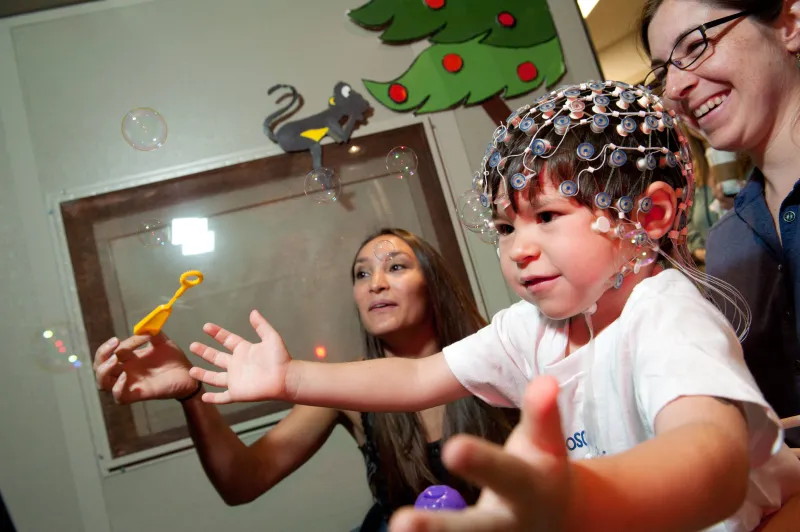
The Nelson Lab focuses on several distinct lines of research, with the overarching goal of elucidating the relation between brain and behavioral (particularly cognitive) development, and in understanding the genetic and environmental factors that impact healthy brain development. The laboratory employs a variety of neuroimaging tools, including the electroencephalogram (EEG), functional Near Infrared Spectroscopy (fNIRS), and Magnetic Resonance Imaging (MRI), along with a variety of behavioral tools.
One line of research reflects Dr. Nelson’s long-standing interest in social information processing and whether individual differences in processing facial emotion in infancy can be linked to the development of psychopathology (particularly internalizing disorders) in childhood. A second line of work focuses on trajectories to autism, with a particular emphasis on populations at elevated likelihood of developing autism (e.g., infants with an older sibling with autism; children with various single gene mutations that appear to confer risk for developing autism; infants growing up in low income/high stress households). A third line of study focuses on the effects of early adversity on brain and behavioral development, including exposure to both psychosocial and biological adversities. This interest is best reflected in three large, longitudinal studies, including the Healthy Brain and Child Development (HBCD), the Bucharest Early Intervention Project (BEIP), and the Bangladesh Early Adversity Neuroimaging (BEAN) project.
Interested in participating in a study?
In every new discovery that we make, through every step forward, we depend upon children and families who support our work by participating in our studies. Your involvement could provide us with valuable insight and can also be a fun, educational opportunity for you and your child. Many of our research studies offer monetary compensation, toys for your child and/or feedback about your child's development.
We invite you to become a part of our team by enrolling in our Participant Registry, which allows us to keep you in the loop about studies for which your child(ren) may be eligible.