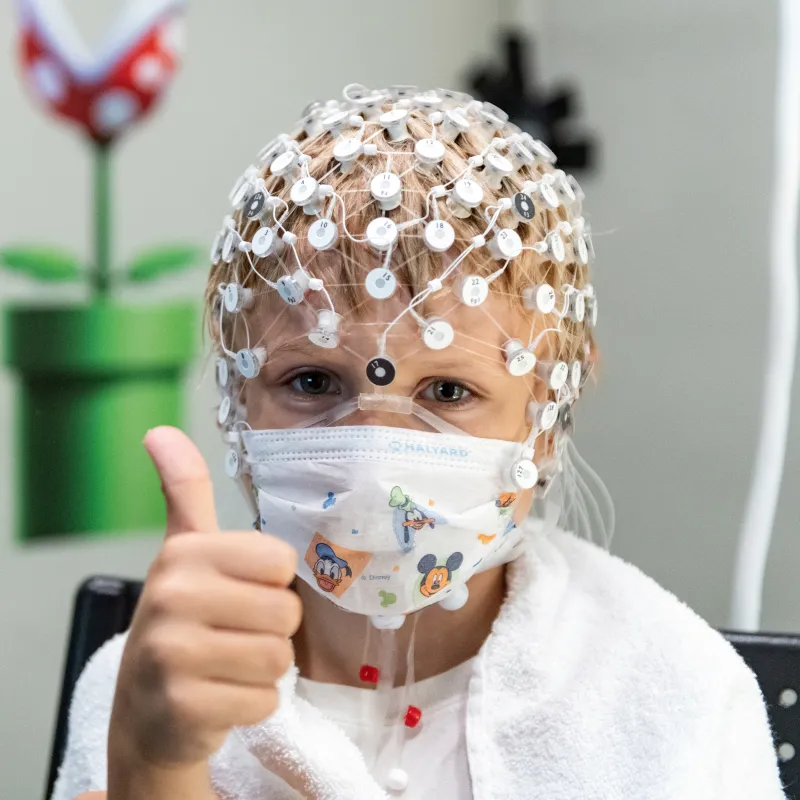
A child holding a thumbs up while wearing an EEG machine on their head.

Join our research

Our research is possible because of families like yours! Visit Our Research to explore current studies or join our Research Participant Registry to stay informed and get involved.

Centralized recruitment initiative

During your visit to the Developmental Medicine Center, you may hear from our centralized recruitment team about optional research opportunities. We may connect in clinic or by phone—feel free to say hello! We're happy to share more if you're interested.
Plan your visit

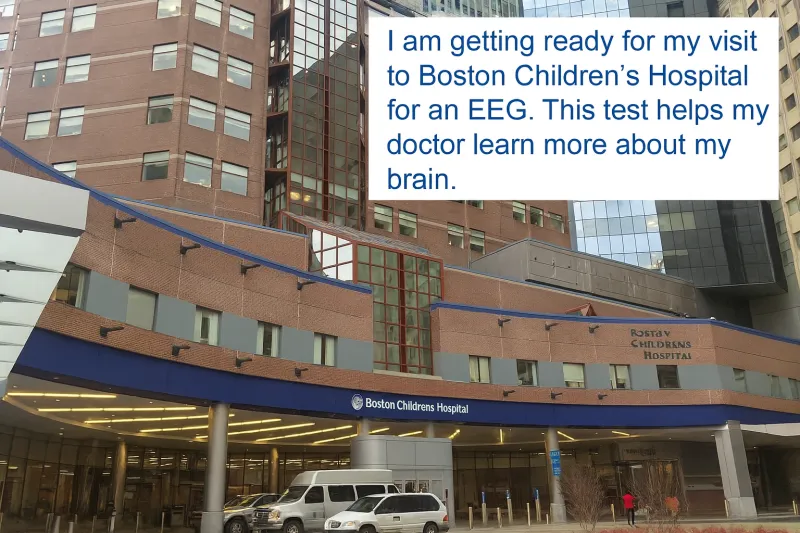
Boston Children's entrance. I am getting ready for my visit to Boston Children's Hospital for an EEG. This test helps my doctor learn more about my brain.

Social stories

Social stories use pictures and words to help kids—and families—prepare for new experiences. Our teams have created stories to introduce what to expect during research visits, including who you’ll meet. 

We recommend reading them with your child a few times before the visit to help everything go smoothly. Clinical stories, like those for blood samples, are also available on the My Hospital Stories page.

Guide for families

Check out our PDF guide to our 2 Brookline Place facility and the surrounding area.

Visit our contact page for information regarding your arrival here via public transportation. 

What have we learned from research?

Read about some of our latest discoveries. Many thanks to the research participants who made it possible.

Associations between ADHD Symptoms and Psychiatric Symptoms in Children: Effects of Functional Impairment and Temperament

Authors: James D Lynch, Sambridhi Subedi, Matthew Zimon, Virginia Peisch, Anne B Arnett 

Children with Attention-Deficit/Hyperactivity Disorder (ADHD) are more likely to experience emotional and behavioral challenges, such as anxiety, depression, and aggressive behavior. To try to understand why this happens, we studied whether difficulties with everyday functioning help explain this relationship and whether a child’s natural emotional style plays a role. Caregivers of 2-4-year-olds or 7-11-year-olds answered questions about their child’s ADHD symptoms, everyday functioning, and their way of responding to and experiencing emotions (temperament). We found that difficulties with everyday functioning helped explain why children with more ADHD symptoms also experienced more symptoms of depression and aggressive behavior in both age groups. Children who experienced negative emotions more strongly were even more likely to experience emotional and behavioral challenges. However, the effect of stronger negative emotions differed between age groups. Younger children were more likely to have mood symptoms, while older children were more likely to have aggressive behavior challenges. These findings suggest that supporting children’s everyday functioning may help reduce the risk of additional mental health concerns in children with ADHD. 

Full article: Associations between ADHD Symptoms and Psychiatric Symptoms in Children: Effects of Functional Impairment and Temperament

The Impact of Face Mask Use on Research Evaluations of 5-7 Year-Old Children With Autism Spectrum Disorder

Authors: Virginia Peisch, Rafael DePillis, Ellen Hanson, Stephanie J Brewster, Georgios Sideridis, William J Barbaresi, Elizabeth Harstad 

The COVID-19 pandemic changed the way many autism research assessments were conducted because children and researchers needed to wear face masks during study visits. We wanted to understand whether wearing face masks affected autism evaluations and whether some children found it easier to wear masks than others. Our study included children ages 5-7 who had been diagnosed with autism when they were toddlers. During the research visits, we assessed cognitive, language, and social communication skills. We also recorded whether children wore a face mask throughout the visit, and whether mask use affected the evaluation. We found that almost all (89%) of children wore a face mask for all or part of their assessment. Children with greater communication and thinking challenges were less likely to wear a mask for the entire visit compared to children with stronger skills in these domains. In most evaluations, research staff reported that wearing face masks did not affect their ability to complete the assessment or make diagnostic decisions. These results suggest that autism research assessments provide reliable information even when face masks are needed for safety reasons. 

Full article: The Impact of Face Mask Use on Research Evaluations of 5-7 Year-Old Children With Autism Spectrum Disorder

Reduced delay-based executive function in autistic toddlers and preschoolers

Authors: Amanda Cremone-Caira, Gina Schnur, Madison Surmacz, Susan Faja 

Being able to wait for a reward and manage impulses is an important part of early childhood development. Delaying reward supports children’s social relationships, learning, and emotional well-being. We wanted to understand when autistic children develop these skills and what strategies they use while waiting for a reward. Autistic and non-autistic 2- and 4-year-olds completed activities that required waiting before receiving a reward, such as a snack, a toy, or another preferred item. We found that autistic children were less likely to wait for rewards than non-autistic children as early as two years of age. Autistic children also appeared less likely to use strategies that can help children wait, such as distracting themselves while the reward was unavailable. These findings could help guide supports that foster the ability to delay reward among young autistic children. 

Full article: Reduced delay-based executive function in autistic toddlers and preschoolers