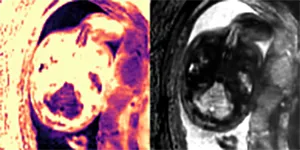
Rapid, high-resolution, and distortion-free fetal brain R2* mapping

two slides of fetal brain imaging

We have developed motion-robust multi-echo radial FLASH acquisition combined with calibrationless model-based reconstruction to achieve rapid, high-resolution, distortion-free R2* mapping of the fetal brain. This method enables robust quantitative imaging within seconds per slice, overcoming fetal motion and field inhomogeneity that have historically limited fetal quantitative MRI.

Wang X, et al., Magnetic Resonance in Medicine, 2025; 94(5): 1913 - 1929. [Paper, Code, Data].
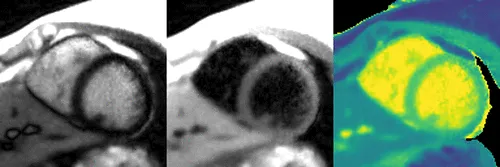
Free-breathing, motion-resolved myocardial T1 mapping

Three slides of myocardial tissue

This project integrates self-gating for contrast-changing acquisitions with motion-resolved model-based reconstruction to accurately estimate myocardial T1 in free-breathing subjects. It enables high-quality cardiac T1 mapping without breath‐holds, expanding access to quantitative myocardial tissue characterization.

Wang X, et al., Magnetic Resonance in Medicine, 2023; 89(4): 1368 - 1384. [Open Access, Code, Data]. Top 10% Downloaded Papers.

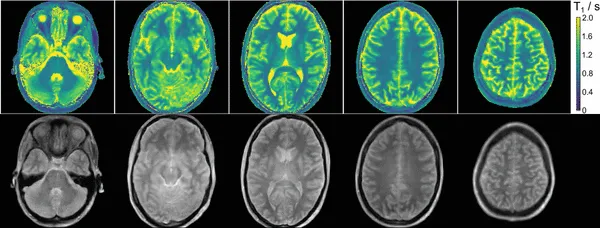
Simultaneous multi-slice T1 mapping in seconds

Ten brain MRI images

We designed a radial simultaneous multi-slice (SMS) acquisition with inversion preparation and nonlinear model-based reconstruction to achieve multi-slice T1 mapping within ~4 seconds. This approach offers dramatic acceleration while maintaining quantitative accuracy, facilitating rapid multiparametric studies.

Wang X, et al., Magnetic Resonance in Medicine, 2021; 85: 1258 - 1271. [Open Access, Code, Data].

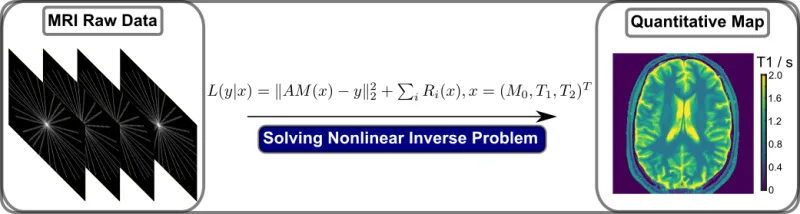
Nonlinear model-based reconstruction for direct parameter estimation

We pioneered a generic nonlinear model-based reconstruction framework that directly estimates quantitative parameter maps from k-space data, bypassing intermediate image reconstructions and improving robustness and flexibility. This framework supports direct regularization on parameter maps and enables arbitrary temporal resolution choices, with applications across sequence types.

Wang X, et al., Philosophical Transactions of the Royal Society A, 2021: 379 (2200), 20200196. [Open Access, Code, Data].

Wang X, et al., Journal of Cardiovascular Magnetic Resonance, 2019; 21: 60. [Open Access, Code, Data]

Wang X, et al., Magnetic Resonance in Medicine, 2018; 79: 730 - 740. [Free full text, BART Demo].

Info graphic of MRI raw data and solvina a nonlinear inverse problem to get a quantitative map of the brain

Infographic illustrating nonlinear model-based MRI reconstruction. The figure shows that quantitative parameter maps are estimated directly from k-space data, without intermediate image reconstruction or pixel-wise fitting. It also highlights direct regularization on parameter maps, such as sparsity constraints, and flexibility in temporal resolution for parameter estimation.